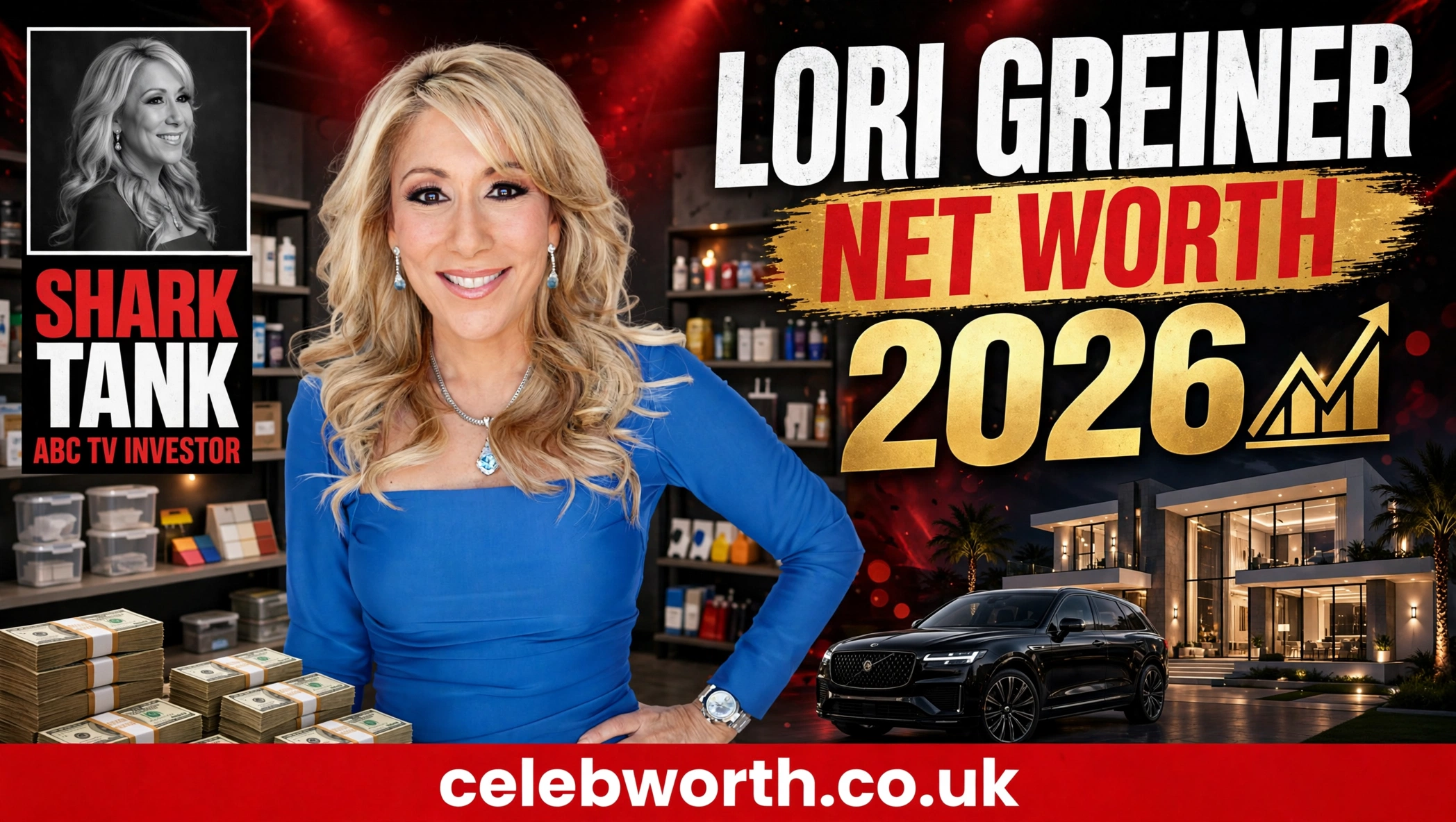
Lori Greiner is known as the Queen of QVC, and lori greiner net worth is one of the most debated figures in the Shark Tank world. She has created more than 1,000 products, holds more than 120 patents, and turned a plastic earring organiser into a retail empire. She then turned that empire into television fame, backing some of the most successful products ever pitched on Shark Tank. Her fortune is real and very large, but its exact size is disputed — even by Greiner herself.
Lori Greiner net worth is estimated at $250 million (est.). That is the figure published by major trackers and repeated by Parade in 2026. Other respected reports put the figure lower, at around $150 million, giving a reported range of $150 million to $250 million. Greiner’s own website has said she is not nearly as wealthy as inflated internet claims suggest, without giving an alternative figure. This article therefore uses $250 million (est.) as the most widely repeated current estimate, while clearly noting the $150 million to $250 million range and the dispute, so readers can judge the figure for themselves.
Lori Greiner Quick Facts
| Detail | Information |
|---|---|
| Full name | Lori Greiner |
| Born | December 9, 1969, in Chicago, Illinois, USA |
| Profession | Inventor, entrepreneur, television personality, author |
| Nickname | Queen of QVC |
| Products created | More than 1,000 |
| Patents held | More than 120 |
| Company | For Your Ease Only, Inc. |
| Best known for | Shark Tank investor since 2012, QVC host |
| Famous investment | Scrub Daddy, $200,000 for 20% in 2012 |
| Husband | Dan Greiner, married since 2010 |
| Children | None, as reported |
| Net worth | $250 million (est.), range $150 million to $250 million |
What Is Lori Greiner Net Worth?
Lori Greiner net worth is estimated at $250 million (est.). The evidence behind that figure, and its limits, can be summarised honestly:
- Major trackers and Parade report $250 million in 2026.
- Several other business and biography sites report around $150 million.
- Greiner does not publish her personal balance sheet, her full investment returns, or her personal assets.
- Her own site disputes inflated internet wealth claims in general terms, without offering a replacement number.
- Company sales figures — for example, Scrub Daddy sales — are not personal income. A company can sell hundreds of millions of dollars of product while its investors receive a much smaller share after costs, taxes, and other shareholders.
The $250 million figure is therefore best read as a working estimate from public sources, not a confirmed total. The $150 million figure shows how much estimates can differ when private-company ownership is involved. Both point to the same conclusion: Greiner is extremely wealthy by any measure, built on products and investments rather than a salary alone.
Her career as an inventor and television investor is summarised on Wikipedia, which covers her QVC work, her patents, and her Shark Tank role.
How Lori Greiner Made Her Money
1. The earring organiser: a $300,000 bet that started everything
Greiner’s story begins with a simple problem: earrings were hard to store. She designed a plastic earring organiser that could hold 100 pairs, took out a $300,000 loan to manufacture it, and bet everything on a single product idea. The gamble worked. The organiser sold well, was picked up by major retailers, and gave her the capital and credibility to build a product business.
That first success taught her the formula she would repeat for decades: find an everyday problem, design a simple and useful solution, protect it with a patent where possible, and sell it through television and retail channels that reach millions of buyers at once.
2. For Your Ease Only and more than 1,000 products
Greiner founded For Your Ease Only, Inc., the company through which she develops and sells her products. Over her career she has created more than 1,000 products and holds more than 120 patents, covering home organisation, kitchen tools, travel accessories, jewellery storage, and many other everyday categories. Not every product is a hit, but the sheer volume matters: a portfolio of many products, sold through QVC and major retailers, can generate steady income even when individual items fade.
Her product strategy has several clear features:
- Solve a visible, everyday frustration that can be shown in a short demonstration.
- Keep the product simple enough to explain in seconds on television.
- Price it for impulse buying, so viewers can order without long deliberation.
- Protect the idea with patents and trademarks where possible.
- Test on QVC, where live sales data shows within minutes whether a product works.
3. QVC: the Queen of QVC
Greiner became one of QVC’s most successful hosts and sellers, earning the nickname Queen of QVC. QVC’s format suited her perfectly: live demonstrations, direct viewer orders, and instant feedback. A strong QVC appearance could sell thousands of units in a single show, and a loyal QVC audience learned to trust her recommendations. Over many years, QVC became both a sales channel and a brand-building platform, making her name familiar to millions of shoppers long before Shark Tank.
QVC income itself is private, but its importance is not just direct commission or salary. QVC gave Greiner distribution, credibility with retailers, and a testing ground for new products. A product that sold on QVC was far easier to place in national retail stores afterwards.
4. Shark Tank: from seller to investor
Greiner joined ABC’s Shark Tank in 2012 and quickly became one of its most successful investors. Her reported pay on the show is around $50,000 per episode, or roughly $1.2 million per season, according to industry estimates repeated by Parade and Variety. That salary is significant, but it is small compared with her investment returns. The real money on Shark Tank comes from owning a share of a company that grows far beyond its pitch-day valuation.
Her Shark Tank approach is distinctive:
- She favours products that can sell on QVC and in mass retail, where she has direct expertise.
- She looks for simple, demonstrable products with broad appeal, not niche technology.
- She often offers to use her QVC and retail network as part of the deal, which is valuable to founders.
- She has invested in a large number of companies, spreading risk across many bets rather than relying on one winner.
Reports have put her total Shark Tank investment at tens of millions of dollars across many deals, although exact totals vary by source and by whether closed, unaired, or later-renegotiated deals are counted.
5. Scrub Daddy: the deal that defined her
Greiner’s most famous Shark Tank investment is Scrub Daddy, the smiling sponge company. In 2012, she agreed to invest $200,000 for 20% of the company. Scrub Daddy went on to become one of the most successful products in Shark Tank history.
The sales figures for Scrub Daddy are often quoted in confusing ways, so they are worth separating:
- Yahoo! Finance reported more than 10 million units sold by mid-2022, with other sources putting revenue at $209 million at that time.
- Greiner’s own portfolio page has claimed more than $2.9 billion in cumulative company sales for Scrub Daddy in later years.
- Forbes reported lifetime sales of about $1 billion and annual revenue of about $350 million in an April 2025 snapshot.
These figures describe company sales, not Greiner’s personal income. Her 20% stake, if fully retained, would be extremely valuable, but distributions, later investment rounds, taxes, and any change in ownership would all affect what she personally received. What is certain is that Scrub Daddy alone turned a $200,000 television deal into one of the most lucrative individual investments in the show’s history, and it cemented her reputation as a shark who could spot a mass-market winner.
6. Squatty Potty and other major wins
Scrub Daddy was not her only success. Squatty Potty, a bathroom stool company she backed, grew to more than $175 million in sales, according to company and press reports. Other Greiner-backed products in home, kitchen, and personal care have also reached national retail. The pattern is consistent: a simple product, a clear demonstration, and Greiner’s retail network turning a television pitch into shelf space across America.
7. Books, speaking, and media
Greiner is the author of Invent It, Sell It, Bank It!: Make Your Million-Dollar Idea into a Reality, a bestselling guide for inventors. Book sales, speaking engagements, and media appearances add income, but their larger value is brand: they position her as an expert inventor, which helps her attract better Shark Tank pitches and better product ideas. For an investor, reputation is a business asset, and Greiner has built hers carefully over decades.
Lori Greiner Earnings Breakdown
| Detail | Information | |
|---|---|---|
| First product | Earring organiser, $300,000 loan | Launchpad for her company |
| For Your Ease Only | 1,000+ products, 120+ patents | Core product business |
| QVC | Long-running host and seller | Nicknamed Queen of QVC |
| Shark Tank salary | Reported $50,000 per episode | Around $1.2 million per season |
| Shark Tank investments | Tens of millions invested in total | Returns private, Scrub Daddy is the standout |
| Scrub Daddy | $200,000 for 20% in 2012 | Company sales in the hundreds of millions to billions, depending on measure and date |
| Squatty Potty | Backed on Shark Tank | More than $175 million in sales reported |
| Book | Invent It, Sell It, Bank It! | Bestselling inventor guide |
| Net worth estimate | $250 million (est.) | Range $150 million to $250 million, disputed in general terms by Greiner herself |
Early Life and Education
Lori Greiner was born on December 9, 1969, in Chicago, Illinois. She grew up in Chicago and studied at Loyola University Chicago, where she studied communications. After college she worked in journalism and related fields before turning to invention. Her first product was not the result of a business-school plan. It came from noticing a problem in her own life, designing a solution, and having the confidence — and the loan — to manufacture it.
That background matters for understanding her wealth. Greiner did not inherit a company or raise venture capital for a technology start-up. She built a product business one item at a time, learned retail from the inside, and then used television to scale what she had already learned.
Personal Life
Greiner has been married to Dan Greiner since 2010. Dan became chief financial officer of her product business, making their partnership both personal and professional. Public biographical reporting says Lori and Dan have no children. She keeps her private life relatively low-key compared with many television stars, and most public attention focuses on her products and investments rather than her personal affairs.
Why the Net Worth Figure Is Disputed
The dispute over Greiner’s net worth is not a scandal. It is a normal result of private wealth. Unlike a public company chief executive, whose shareholdings are disclosed, Greiner’s wealth sits in private companies, product royalties, and investment stakes that are not published. Trackers must estimate the value of those stakes from company sales, typical margins, and reported deal terms, and different assumptions produce very different totals.
Lessons From Lori Greiner’s Career
- Start with a problem you understand. Her first product solved her own storage frustration.
- Volume beats perfection. More than 1,000 products gave her many chances for a hit.
- Distribution is as valuable as invention. QVC and retail networks turned good products into national sellers.
- Demonstration sells. Products that can be shown working in seconds do best on television.
- Company sales are not personal wealth. Always separate a company’s revenue from an investor’s personal fortune.
If you want to compare inventors and investors, try the Celebrity Net Worth Battle, find a birthday twin with the Birthday Twin Finder, or browse more profiles on the Net Worth hub. You can also start from the CelebWorth homepage or explore all tools on the Tools page.
Why Two Very Different Net Worth Figures Both Circulate
Lori Greiner’s net worth is estimated at $250 million (est.), the figure published by major trackers and repeated by Parade in 2026, while other respected reports put the figure lower, at around $150 million, giving a reported range of $150 million to $250 million. That $100 million gap is not a scandal, and it is not a sign that one side has made its number up. It is a normal result of private wealth. Unlike a public company chief executive, whose shareholdings are disclosed, Greiner’s wealth sits in private companies, product royalties and investment stakes that are not published, so trackers must estimate the value of those stakes from company sales, typical margins and reported deal terms, and different assumptions produce very different totals.
Greiner’s own position adds to the uncertainty in an honest way. Her own website has said she is not nearly as wealthy as inflated internet claims suggest, without giving an alternative figure, and she does not publish her personal balance sheet, her full investment returns or her personal assets. This article therefore uses $250 million (est.) as the most widely repeated current estimate, while clearly noting the $150 million to $250 million range and the dispute, so readers can judge the figure for themselves. Both ends of the range point to the same conclusion: Greiner is extremely wealthy by any measure, built on products and investments rather than a salary alone.
One common error explains a large part of the confusion, and it applies to almost every Shark Tank fortune. Company sales figures are not personal income. A company can sell hundreds of millions of dollars of product while its investors receive a much smaller share after costs, taxes and other shareholders. That distinction runs through the whole Scrub Daddy story below, and it is the single most useful rule for reading any figure attached to Greiner’s name: always separate a company’s revenue from an investor’s personal fortune.
The Product Machine: 1,000 Products and 120 Patents
Greiner’s story begins with a simple problem: earrings were hard to store. She designed a plastic earring organiser that could hold 100 pairs, took out a $300,000 loan to manufacture it, and bet everything on a single product idea. The gamble worked. The organiser sold well, was picked up by major retailers, and gave her the capital and credibility to build a product business. That first success taught her the formula she would repeat for decades: find an everyday problem, design a simple and useful solution, protect it with a patent where possible, and sell it through television and retail channels that reach millions of buyers at once.
She founded For Your Ease Only, Inc., the company through which she develops and sells her products, and over her career she has created more than 1,000 products and holds more than 120 patents, covering home organisation, kitchen tools, travel accessories, jewellery storage and many other everyday categories. Not every product is a hit, but the sheer volume matters: a portfolio of many products, sold through QVC and major retailers, can generate steady income even when individual items fade. Volume beats perfection, because a thousand chances for a hit are worth more than one perfect idea that never reaches a shelf.
- Solve a visible, everyday frustration that can be shown in a short demonstration, so a viewer understands the product in seconds.
- Keep the product simple enough to explain in seconds on television, because a complicated product cannot be sold in a short live segment.
- Price it for impulse buying, so viewers can order without long deliberation.
- Protect the idea with patents and trademarks where possible, so a successful design cannot simply be copied by a rival.
- Test on QVC, where live sales data shows within minutes whether a product works, before committing to national retail.
QVC itself deserves a closer look, because it is both a sales channel and a brand-building platform. Greiner became one of QVC’s most successful hosts and sellers, earning the nickname Queen of QVC, and the format suited her perfectly: live demonstrations, direct viewer orders and instant feedback. A strong QVC appearance could sell thousands of units in a single show, and a loyal QVC audience learned to trust her recommendations. QVC income itself is private, but its importance is not just direct commission or salary. QVC gave Greiner distribution, credibility with retailers and a testing ground for new products, and a product that sold on QVC was far easier to place in national retail stores afterwards. She built her name with millions of shoppers long before Shark Tank, which is why her television investing career started from a position of retail strength rather than from fame alone.
Scrub Daddy and Squatty Potty: Reading the Sales Figures Carefully
Greiner joined ABC’s Shark Tank in 2012 and quickly became one of its most successful investors. Her reported pay on the show is around $50,000 per episode, or roughly $1.2 million per season, according to industry estimates repeated by Parade and Variety. That salary is significant, but it is small compared with her investment returns, because the real money on Shark Tank comes from owning a share of a company that grows far beyond its pitch-day valuation. Reports have put her total Shark Tank investment at tens of millions of dollars across many deals, although exact totals vary by source and by whether closed, unaired or later-renegotiated deals are counted. Her approach is distinctive: she favours products that can sell on QVC and in mass retail, where she has direct expertise, she looks for simple, demonstrable products with broad appeal rather than niche technology, she often offers her QVC and retail network as part of the deal, and she has invested in a large number of companies, spreading risk across many bets rather than relying on one winner.
| Investment | Deal as reported | Company sales as reported | What it means for her personally |
|---|---|---|---|
| Scrub Daddy | $200,000 for 20% in 2012 | More than 10 million units sold by mid-2022, revenue of $209 million at that time; Forbes lifetime sales of about $1 billion and annual revenue of about $350 million in an April 2025 snapshot; her portfolio page claims more than $2.9 billion in cumulative company sales in later years | Her 20% stake, if fully retained, would be extremely valuable, but distributions, later investment rounds, taxes and any change in ownership would all affect what she personally received |
| Squatty Potty | Backed on Shark Tank | More than $175 million in sales, according to company and press reports | A second major win following the same pattern: a simple product, a clear demonstration and retail distribution |
| Other backed products | Many deals across home, kitchen and personal care | Several reached national retail | Spread risk: many bets rather than one winner |
The Scrub Daddy figures are often quoted in confusing ways, so they are worth separating carefully. Yahoo! Finance reported more than 10 million units sold by mid-2022, with other sources putting revenue at $209 million at that time. Greiner’s own portfolio page has claimed more than $2.9 billion in cumulative company sales for Scrub Daddy in later years. Forbes reported lifetime sales of about $1 billion and annual revenue of about $350 million in an April 2025 snapshot. Those figures describe company sales at different dates and on different measures, not Greiner’s personal income, and they should not be added together or treated as a single total. What is certain is that Scrub Daddy alone turned a $200,000 television deal into one of the most lucrative individual investments in the show’s history, and it cemented her reputation as a shark who could spot a mass-market winner.
Squatty Potty, a bathroom stool company she backed, grew to more than $175 million in sales, according to company and press reports, and other Greiner-backed products in home, kitchen and personal care have also reached national retail. The pattern is consistent across all of them: a simple product, a clear demonstration, and Greiner’s retail network turning a television pitch into shelf space across America. Books, speaking and media add further income, including her bestselling guide Invent It, Sell It, Bank It!: Make Your Million-Dollar Idea into a Reality, but their larger value is brand: they position her as an expert inventor, which helps her attract better Shark Tank pitches and better product ideas, and for an investor, reputation is a business asset built carefully over decades.
Glossary: Terms Behind the Headlines
A few terms recur throughout Greiner’s story, and each one helps readers judge the fortune attached to her name.
- Patent: A legal protection for an invention. Greiner holds more than 120 patents, which protect her product designs from direct copying where possible.
- Equity stake: An ownership share in a company. Her Scrub Daddy deal gave her 20% of the company for $200,000 in 2012.
- Pitch-day valuation: The value placed on a company at the time of its television pitch. The real money on Shark Tank comes from owning a share of a company that grows far beyond that valuation.
- Cumulative company sales: The total sales of a company added up over its whole life. Her portfolio page claims more than $2.9 billion in cumulative company sales for Scrub Daddy, which is a company figure, not her personal income.
- Distribution: The network of channels that gets a product to buyers. QVC and national retail gave Greiner distribution, which she regards as being as valuable as invention itself.
- Impulse buying: A purchase made quickly, without long deliberation. Her products are priced for impulse buying, so television viewers can order at once.
- Per-episode pay: The fee for each episode of a show. Her reported Shark Tank pay is around $50,000 per episode, or roughly $1.2 million per season, which is small compared with her investment returns.
- Queen of QVC: Her nickname as one of QVC’s most successful hosts and sellers, earned through years of live demonstrations and direct viewer orders.
FAQs
What is Lori Greiner net worth?
Lori Greiner net worth is estimated at $250 million (est.), with other reports giving around $150 million. The reported range is therefore $150 million to $250 million, and Greiner herself has disputed inflated internet claims without giving an alternative figure.
What is Lori Greiner’s most successful Shark Tank investment?
Scrub Daddy is widely regarded as her most successful investment. She invested $200,000 for 20% in 2012, and the company went on to generate hundreds of millions of dollars in sales, with later claims of billions in cumulative sales.
How many products has Lori Greiner created?
She has created more than 1,000 products and holds more than 120 patents, according to her official biography.
How much does Lori Greiner earn on Shark Tank?
She is reported to earn around $50,000 per episode, or roughly $1.2 million per season, although her investment returns are far larger than her salary.
Is Lori Greiner married?
Yes. She has been married to Dan Greiner since 2010, and he serves as chief financial officer of her product business.
What is Lori Greiner’s book called?
Her book is Invent It, Sell It, Bank It!: Make Your Million-Dollar Idea into a Reality.
Conclusion
Lori Greiner net worth, estimated at $250 million (est.) within a reported range of $150 million to $250 million, reflects a career built product by product. She began with a $300,000 loan and a plastic earring organiser, built For Your Ease Only into a company behind more than 1,000 products, became the Queen of QVC, and then used Shark Tank to back Scrub Daddy and Squatty Potty into national successes. The exact size of her fortune is disputed, and her own warning against inflated claims should be kept in mind, but the scale of her achievement is not in doubt. Few inventors have turned everyday ideas into retail empires so consistently, and few television investors have spotted mass-market winners so reliably. That record, more than any single number, is why Lori Greiner remains one of America’s most respected product entrepreneurs.